Bize ev sahipliği yapan galaksimiz ve sonlandığı nokta hayallerimizi zorlayacak kadar geniş olan/genişleyen evrenimiz hakkındaki görsel güzellikleri bu başlık altında biriktirebiliriz :)(:
İyi paylaşımlar dilerim.
Bize ev sahipliği yapan galaksimiz ve sonlandığı nokta hayallerimizi zorlayacak kadar geniş olan/genişleyen evrenimiz hakkındaki görsel güzellikleri bu başlık altında biriktirebiliriz :)(:
İyi paylaşımlar dilerim.
Teşekkürler..
Ben de şu iki video’yu paylaşayım: Birincisi Cassini uzay aracıyla Satürn’ün etrafında kısa bir yolculuk, çok beğendiğim bir animasyon
Videonun sonundaki Enceladus yakın uçuşuna bayılıyorum :).
bir video daha paylaşayım ama bunu çok yalın bulabilirsiniz ama ben gene de beğeniyorum; New Horizons uzay aracından Jupiter’in dönüşü. Belki hatırlayanlar vardır New Horizsons, Jupiter’e yakın geçişi sırasında en hızlı hareket eden insan yapımı araç olmuştu.
Bu arada New Horizons demişken de.. Plüton’un gezegenlikten çıkarılmasına sebep olan Eris’in sanıldığı kadar büyük olmayabileceği söylenmeye başlandı, Plüton’dan küçük bile olabilirmiş. 🙂
Arada güzel videolara denk geldikçe burada da paylaşırım…
İnanılmaz bir güzellik, büyüleyici, muhteşem…
Ama bi dakka bi dakka, şimdi siz bütün bunların “tesadüf” eseri oluştuğunu mu söylüyorsunuz yaneeaaeeaaa?!
:))
Candor Chasma animation using HiRISE DTM
This is an animation flying over southwest Candor Chasma on Mars. It was created from NASA’s HiRISE DTM and image data. The spatial resolution is 1 meter for the altimetry data and 0.25 meters for the image data. There is no vertical exageration.
The animation was created using Mars Explorer and was captured in realtime.
Da will ich auch hin, menno ;-))
İnanılmaz yüzey şekilleri, basit bir çöl gezegeni değil besbelli. Eskiden çok hareketli bir gezegenmiş gibi duruyor. Maden alanına benzeyen yerler uzun paralel izler falan ilginçti, hareket eden buzulların şekillendirmeleri midir nedir.
Mars’tan bir başka yeryüzü şekli, Echus Chasma. Uçurumun yüksekliği 4km kadarmış.
4 gün sonra Curiosity fırlatılacak. Aşağıda Mars’a inişini anlatan bir videoyu koyuyorum. Mars’ta Gale Krateri’ne inecekmiş. Bu kraterin ortasında birkaç kilometre yüksekliğinde bir tepe varmış ve tortul yapıdaymış ve Mars’ın geçmişi hakkında değerli bilgiler edinebilecekmişiz.
Eski bir derleme, herkes gormustur ama dursun burada da 🙂
Benden çok yaşayacaksın G Milat.
Bu da gene ünlü bir video, ödüllü. vimeo’daki açıklamaları da yapıştırayım..
KaptanMosey, senden cok yasar miyim bilmem ama yasam suresi icersinde -simdiye kadar buldugum- en sakin evren videosu sana gelsin 🙂
Flying through a evolving cosmic structure, starting at early times (the so called dark ages), where the material in the universe is in a cold and neutral state. First objects collapse and form the first proto galaxies embedded in a heated atmosphere, hosting the first stars and QSOs. The energetic light from those stars/QSOs heat and ionize the material in the universes (note that this simulation takes this not self consistently into account, but uses a uniform, time dependent background radiation field), revealing the fine, filamentary structures formed so far. Now, lager and larger structures form within a long and violent process of merging of smaller structures leading to the largest objects observed in the present universe, the so called galaxy clusters, still connected to each other by filamentary structures. At the end, the movie zooms down to a spiral galaxy, similar to what we expect the Milky Way looks like, for a final fly-by. In this case the galaxy is artificial constructed from an astronomical image, as it is still impossible to obtain such detailed and realistic galaxies directly within cosmological simulations. This movie is also shown in the Virtual Reality facility of the new Turin Planetarium.
Annnndd Calimera 🙂
how have you been out there? I like your pretty cool videos which you posted here. As I know u are interested in astronomy as well.I guess u can find the constellations of Zodiac and the others such as Sirius(in spring) or Orion.
Here is the video for u about the Orion Nebula which is a cavern of rolling dust and gas where thousands of shiny stars…
Enjoy :)(:
This sequence zooms on three ground-based images and ends up with the new Hubble image of the Orion Nebula M42.
Gamaro 🙂
Bu kadari da tesaduf olamaz herhal 😀
teşekkürler 🙂
aaah yes G Milat, thanks a lot – I like astronomies very very much 😉
Aurora’yı görmek istiyorum :((
10 Aralık 2011, Türkiye saati ile 16:37’de Ay tutulması 🙂
Kaçırmayın 🙂
Kuzey Işıkları’nın sırrı
Alaska’da görev yapan bilimadamları, “Aurora Borealis” adıyla da bilinen Kuzey Işıkları’nı anlamak ve insanların yaşamı üzerinde etkilerini incelemek üzere kolları sıvadı.
Kutuplarda kurulu özel bir merkezde görev yapan uzmanlar bu gizemli ışık fırtınalarını daha iyi anlamayı ve insan yaşamına etkilerini azaltabilmeyi umuyor. Kuzey Kutbu’nda yaşayan ilk insanlar, “Aurora Borealis”, yani Kuzey Işıkları’nın aslında gökyüzünde “danseden ruhlar” olduğuna inanıyorlardı.
Gökyüzünde tuhaf, değişik renklerde ışımalar halinde görülen “Kuzey Işıkları” dünyanın kutup bölgelerine pek çok turist çekiyor. Ancak bu ışımalar, bölgede yaşayanların hayatlarına etki edebiliyor, kuzey yarıkürede örneğin güç kaynaklarının azalmasına ya da uydu sistemlerinde arızalar yaşanmasına neden olabiliyor. Petrol boru hatlarında dahi aşınmalara yol açabiliyorlar.
Bunlar aynı zamanda dünyanın çevresinde jeomanyetik alanda oluşan fırtınaların göze görünen şekli. Bugün, bu ışımalara güneşten gelen ve kutuplardaki manyetik alanlara sürüklenen elektrik yüklü parçacıkların yol açtığı biliniyor.
Büyükçe bir Aurora fırtınası, Kuzey yarıküre boyunca, güç kaynaklarını, uydu iletişim sistemlerini bozmaya yeterli. O nedenle Aurora’yı anlamak büyük önem taşıyor.
Alaska’nın merkezinde bulunan Poker Flat Araştırma Merkezi, Aurora Borealis’in en iyi filme çekildiği yerlerin başında geliyor. Burası aynı zamanda dünyada bilimsel amaçlı roket fırlatma özelliğine sahip tek akademik merkez. 1969 yılından bu yana atmosferdeki etkileşimlerin anlaşılabilmesi, yeni perspektifler edinilebilmesi için bu merkezden yüzlerce roket fırlatıldı.
Profesör Dirk Lummerzheim 10 yıldır, Kuzey Işıkları’nı inceliyor. Lummerzheim proje kapsamında gelişmiş teknolojiyle havaya gönderilen ses roketlerinden gelen verileri birleştiriyor. Profesör Lummerzheim, üst atmosferin aurora ile nasıl harekete geçtiğini anlamaya çalıştıklarını belirtiyor. Buna göre uzmanlar, Kuzey Işıkları’nın oluştuğu noktalara ölçüme uygun ses roketleri fırlatıyor. Bu roketler atmosferde yükselirken, bir tür duman bırakıyor, bu duman gelişmiş film malzemeleriyle kaydedilebiliyor.
Araştırmacılar ardından bu duman izlerinin alçalma hızına, dolayısıyla geçtikleri noktalardaki rüzgar hızına bakabiliyor. Uzmanlar bu ölçümleri kullanarak jeomanyetik faaliyetleri daha iyi anlayabilmeyi ve nihayetinde oluşacakları zamanı daha iyi tahmin edebilmeyi ve etkilerinden korunabilmeyi umuyor.
*ntvmsnbc.com
Imagine, not flying over the earth, but over an alien civilization, what also for another feeling it could be 😉
Plüton’da ‘yaşam’ izi..
Amerikan Uzay ve Havacılık Dairesi (NASA), Plüton gezegeninin yüzeyinde yaşamın yapı taşlarına rastladı.
NASA, Plüton’da yaşamın yapı taşları olarak bilinen hidrokarbon molekülleri buldu.
Biliamadamları, Hubble Uzay Teleskopu’yla cüce gezegenin kayalık ve buzlu kaplı yüzeyinde ultraviyole ışıklarının emildiğini keşfettiklerini, bunun da Pluton’da karmaşık hidrokarbon moleküllerin var olduğunu kanıtladığını açıkladı.
KIRMIZI RENGİNİN SIRRI
Bu moleküllerin, güneş ışığı ya da kozmik ışınların gezegenin yüzeyindeki buzda bulunan metan, karbonmonoksit ve nitrojen ile etkileşime geçmesi sonucu ortaya çıktığı ve gezegene kırmızı rengini verdiği sanılıyor.
Kaynak: Ntvmsnbc news
Aşagıdaki NASA tarafından hazırlanmış videoda, Plüton’un hazin hikayesi var 😀
Olasılıklar Evreni 🙂
Videoda gördüğünüz her bir ışık noktası, farklı bir galaxiyi temsil ediyor. Evrenin ne kadar büyük olduğu ise, hayal gücünü zorlayıcı cinsten..
Ölüm Yıldızı
Vikipedi, özgür ansiklopedi
Yıldız Savaşları araç
Ölüm Yıldızı
İmalatçı Geonosisler
Sınıflandırma İmparatorluk Savaş İstasyonu
Tip Savaş silahı
Uzunluk 160 km. çapında
Silahlar Süper lazer (1032 joule’lük enerjiye sahip.)
10.000 turbo lazer
2.500 iyon topu
700 ışın alanı projektörü
Kalkan Askeri kalkan
Araç yapısı Savaş istasyonu
Mürettebat 27.048 subay
774.576 pilot, er ve erbaş
400.000 teknik destek elemanı
25.000 özel kuvvet askeri
En yüksek hız –
Bölük taşıma kapasitesi Mürettebata ek olarak; 7,200 TIE fighter savaş gemisi ve ekipmanı.
İlgili birlik Galaktik İmparatorluk
Kargo kapasitesi Mürettebat ve askeri birlikler için gerekli tüm ekipman.
Yolcu kapasitesi –
Ölüm Yıldızı, Yıldız Savaşları dizisinde, İmparatorluğun en ölümcül silahı ve ayrıca İmparatorluğun merkezi üssüdür. Ağır bir İmparatorluk Savaş İstasyonu/Süper Silah’ı olup 160 kilometre çapındadır. İstasyonun temel şekli, küçük bir Ay boyutlarında küre şeklindedir. Ekvator çevesindeki bir kilometre genişliğindeki çukur tersane ve limanlara gitmektedir. Tarkin Doktrini ile kendisini göstermiştir.
Ölüm Yıldızı gayet büyük ve geniştir. I. Ölüm Yıldızı’nın 400.000 mürettebatı, 1.400 droid ve savaş gemileri ile çok sayıda kontrol odası vardır. II. Ölüm Yıldızı’nda ise bunun iki katı kadar mürettebat ve güç vardır.
Ölüm Yıldızı’nın zayıf noktası ise egzoz çıkışı ve jeneratörleridir. Güç jeneratörleri de egzoz çıkışında bulunmaktadır. İlginçtir ki, I. Ölüm Yıldızı egzoz girişinden aldığı hasar ile, ikincisi ise jeneratör çekirdeklerine aldığı hasar ile yok edilmiştir.
Tarihi [değiştir]
Ayrılıkçılar kendi aralarında yapmış oldukları antlaşma gereği, Ölüm Yıldızı’nın başlangıç teknik tasarımları Geonosisler tarafından yaratılmış olup bilinen en son silahlarıdır. Geonosianslı lider Yüce Akhun geri dönüştürdükleri çok gizli tasarımlarını Kont Dooku’ya, Geonosis Savaşı sırasında Jedilar’ın eline düşmeden teslim etmeyi başardılar. Dooku da bu gizli tasarımla Coruscant’e geri dönerek tasarımı Sith Lord’u olan Darth Sidious’a teslim etti. Bu tasarım planı ile ilerideki yıllarda Grand Moff Tarkin ve Raith Sienar’ın görüşleri de katılarak uzun süre yolculuk yapabilecek bir savaş istasyonu inşa edilmeye başlanacaktır.
Klon Savaşları sırasında, Palpatine tarafından Mygeeto gönderilen 501. Lejyon’un görevi I. Ölüm Yıldızı’nın SüperLazer’i için kullanılacak olan Örnek Enerji’yi toplamaktı.
Kısaca, Darth Sidious’un emriyle Ölüm Yıldızı’nın yapımı ancak Galaktik İmparatorluk tarafından biçimlendirilip yeni formuyla güvenli bir biçimde inşa edilmeye başlanılabilmiş, Tarkin’in yönettiği gelişmiş gizli bir projedir. Tarkin’in yaratıcı çalışması ve kafasındaki düşüncülerin bir ürünü sonucu meydana gelen Ölüm Yıldızı, İmparatorluğun en son silahıdır.
Uzun bir süre yapımı süren I. Ölüm Yıldızı’nın en üst rütbeli görevlisi Tarkin’dir. Darth Vader, bayrak gemisi Executor’un ağır savaşlarda aldığı hasarlar üzerine bakım görmesi nedeniyle Ölüm Yıldızı’na gider. Executor’un bakımı bitmesine rağmen yine de Ölüm Yıldızı’nda kalır. O kadar güçlü bir silahtır ki tek bir atışta bir gezegeni atomlarına ayırıabilir. Buna en güzel örnek Alderaan gezegenidir. Bu korkunç silahın ilki Yavin Savaşı’nda Luke Skywalker tarafıdan yok edilmiştir. İkincisinin yapımı üç yıllık bir sürede acele bir biçimde yapılmıştır ancak Endor Savaşı başlamadan tam olarak tamamlanamamıştır
II. Ölüm Yıldızı [değiştir]
II. Ölüm Yıldızı’nın en üst rütbeli görevlisi ise Moff Jerjjerod’dir. Endor Savaşı sürerken, Vader’ın Taç Odası’nda bulunduğu sırada Ölüm Yıldızı, Lando Calrissia
Yıldız takımları..
Kuzey yarım küreden kış mevsimi boyunca görünen yıldız takımları..
Güneş nasıl yok olacak..
Karanlık madde ve karadelikler üzerine bir anlatım. Evrenin her yöne nasıl dağıldığı hakkında geniş bilgi veriliyor.
DARK ENERGY
Cosmology, the study of the universe as a whole, has been turned on its head by a stunning discovery that the universe is flying apart in all directions at an ever-increasing rate.
Is the universe bursting at the seams? Or is nature somehow fooling us?
The astronomers whose data revealed this accelerating universe have been awarded the Nobel Prize for Physics.
And yet, since 1998, when the discovery was first announced, scientists have struggled to come to grips with a mysterious presence that now appears to control the future of the cosmos: dark energy.
On remote mountaintops around the world, major astronomical centers hum along, with state of the art digital sensors, computers, air conditioning, infrastructure, and motors to turn the giant telescopes.
Deep in Chile’s Atacama desert, the Paranal Observatory is an astronomical Mecca.
This facility draws two megawatts of power, enough for around two thousand homes.
What astronomers get for all this is photons, tiny mass-less particles of light. They stream in from across time and space by the trillions from nearby sources, down to one or two per second from objects at the edge of the visible universe.
In this age of precision astronomy, observers have been studying the properties of these particles, to find clues to how stars live and die, how galaxies form, how black holes grow, and more.
But for all we’ve learned, we are finding out just how much still eludes our grasp, how short our efforts to understand the workings of the universe still fall.
A hundred years ago, most astronomers believed the universe consisted of a grand disk, the Milky Way. They saw stars, like our own sun, moving around it amid giant regions of dust and luminous gas.
The overall size and shape of this “island universe” appeared static and unchanging.
That view posed a challenge to Albert Einstein, who sought to explore the role that gravity, a dynamic force, plays in the universe as a whole.
There is a now legendary story in which Einstein tried to show why the gravity of all the stars and gas out there didn’t simply cause the universe to collapse into a heap.
He reasoned that there must be some repulsive force that countered gravity and held the Universe up.
He called this force the “cosmological constant.” Represented in his equations by the Greek letter Lambda, it’s often referred to as a fudge factor.
In 1916, the idea seemed reasonable. The Dutch physicist Willem de Sitter solved Einstein’s equations with a cosmological constant, lending support to the idea of a static universe.
Now enter the American astronomer, Vesto Slipher.
Working at the Lowell Observatory in Arizona, he examined a series of fuzzy patches in the sky called spiral nebulae, what we know as galaxies. He found that their light was slightly shifted in color.
It’s similar to the way a siren distorts, as an ambulance races past us.
If an object is moving toward Earth, the wavelength of its light is compressed, making it bluer. If it’s moving away, the light gets stretched out, making it redder.
12 of the 15 nebulae that Slipher examined were red-shifted, a sign they are racing away from us.
Edwin Hubble, a young astronomer, went in for a closer look. Using the giant new Hooker telescope in Southern California, he scoured the nebulae for a type of pulsating star, called a Cepheid. The rate at which their light rises and falls is an indicator of their intrinsic brightness.
By measuring their apparent brightness, Hubble could calculate the distance to their host galaxies.
Combining distances with redshifts, he found that the farther away these spirals are, the faster they are moving away from us. This relationship, called the Hubble Constant, showed that the universe is not static, but expanding.
Einstein acknowledged the breakthrough, and admitted that his famous fudge factor was the greatest blunder of his career.
Insan tarafindan 1957den sonra üretilip bugüne kadar uzayda biriken cöpler. Uzay cöplügü büyüyor 😉
Bütün bu muhteşemlikleri bizim bildiğimiz her hangi bir tanrının yaratmış olması mümkün değil 🙂
Bu videoyu Aurora nickli üyeye adıyorum :)) Yani ismim G Milat olmasa kesin Aurora olurdu herhalde 🙂
Bu başlığı unutmuştum. Şimdi görünce benim de aklıma şu geldi: geçenlerde APOD’ta çok güzel bir uygulama paylaşılmıştı, en azından ben çok beğenmiştim. Burada da paylaşmak istiyorum… ama nasıl gömeceğimi bilemedim o yüzden linkini vereyim…
link to apod.nasa.gov
ışıktan bir nehir 🙂
Genelde yaz aylarında görmüşsünüzdür..küçük hortumlara(tornado) benzeyen hava girdapları oluşur. Ortalığı toza dumana katar..Dünyamıza özgü bir şey değilmiş bakın bu da Mars yüzeyinde oluşmuş bir örneği…16 şubatta yörüngedeki Mars Reconnaissance Orbiter uydusu tarafından yakalanmış…
Here also a video from this “Dust Devil” on Mars
Self-portrait Opportunity, Sol 2811 (21. december 2011) at “Greeley Haven”, in a winter rest period. The roverdeck is now full of dust, but still working. Opportunity will stay in this region until June 2012, when the sun will be back on the highest point to “feed” its solar cells optimal:
Here a picture from the overwinter place “Greeley Heaven”:
Bugün dolunay olarak Ay’ın Dünya’ya en yakın olduğu halini gözlemleyebilirsiniz.
“May 2, 2012: The full Moon has a reputation for trouble. It raises high tides, it makes dogs howl, it wakes you up in the middle of the night with beams of moonlight stealing through drapes. If a moonbeam wakes you up on the night of May 5th, 2012, you might want to get out of bed and take a look. This May’s full Moon is a “super Moon,” as much as 14% bigger and 30% brighter than other full Moons of 2012.
The scientific term for the phenomenon is “perigee moon.” Full Moons vary in size because of the oval shape of the Moon’s orbit. The Moon follows an elliptical path around Earth with one side (“perigee”) about 50,000 km closer than the other (“apogee”). Full Moons that occur on the perigee side of the Moon’s orbit seem extra big and bright. ”
link to science.nasa.gov
Aşağıdaki videoda da dolunayın insan üzerinde herhangi bir etkisinin olup olmadığının açıklaması var.
Ruslara ait Electro-L meteoroloji uydusu yerden 40 bin km yukarda ve her 30 dakikada bir 121 megapiksel boyutunda resimler çekiyor.O resimler kullanılarak yapılmış kuzey yarımküreye ait güzel bir timelapse.
G Milat, bugün günbatımında sizin oralarda güneş tutulması olacak galiba :). Fotoğraflarını bizimle paylaşırsın…
Güzel bi gif buldum, ekliyorum G Milat. 🙂


NASA APOD günbatımında güneş tutulması manzaralarıyla ilgli merakımı biraz giderdi. Bugünkü resmin konusu bu…
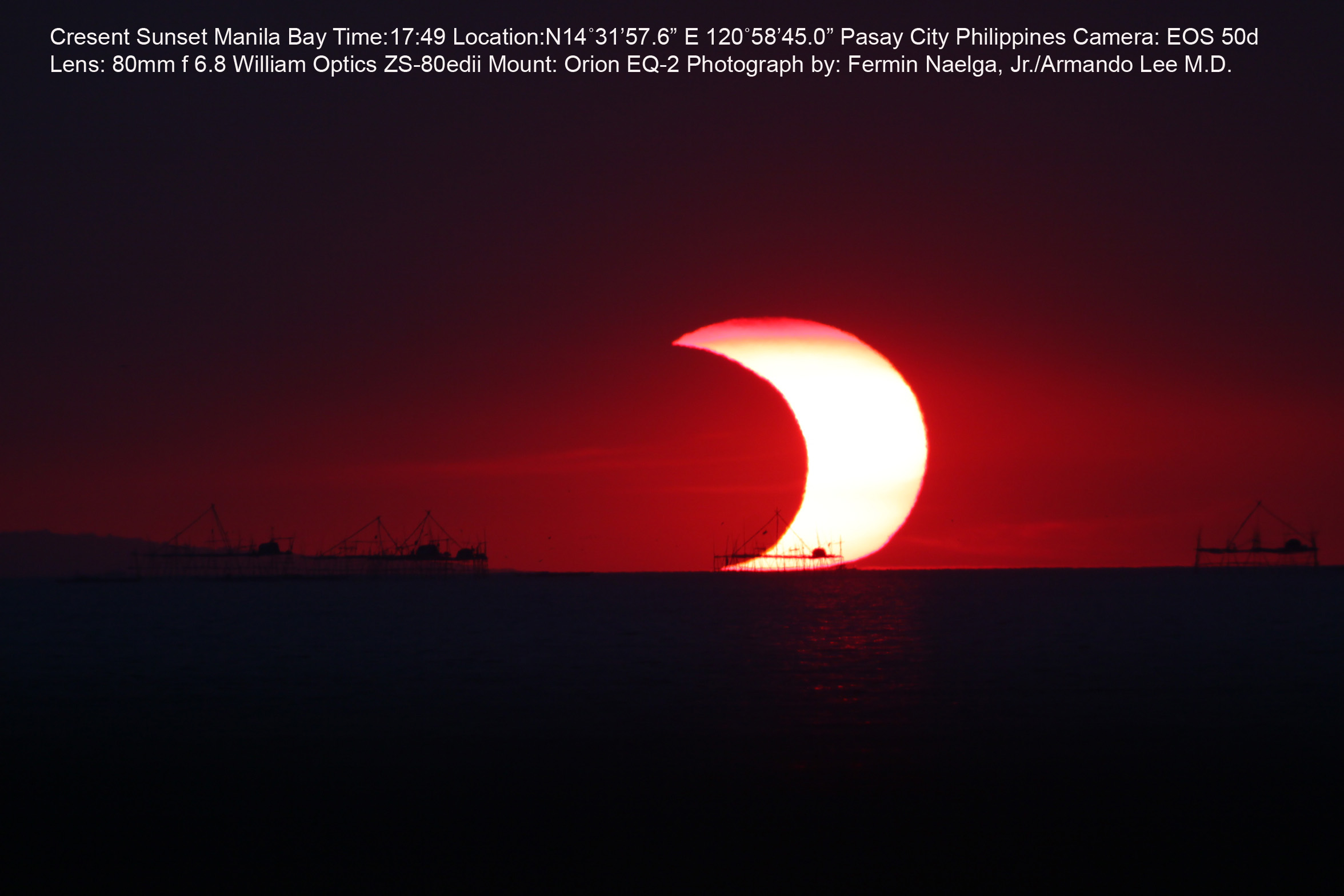
Buna benzer kareler bekliyorum :).
Sound source – possible associated with aurora borealis – localized.
A recording produced on Sept 9-10 2011 during a geomagnetic storm by using three microphones and a VLF antenna picked up twenty similar clap sounds. Some of them were close enough in order to be detected by all three microphones. The collected data allowed the estimation of the location of the sound source. The sound source was on the open sky. Preliminary results will be published July 10 2012 in Vilnius:
The result shows that the sound source – at this particular case – was real and on the sky, not far away from the ground.
-The result does not explain the physical mechanism behind these clap sounds. It just estimates the location of the sound source of this event.
11 milyar yil yasindaki bu galaksi, ilk spiral galaksi. Big bang’ten 3 milyar yil sonra olustu. Daha onceki galaksiler düzensiz, daginik, sekilsiz.
Karanlık Madde’nin gerçek olduğu bilimadamlarınca kabul edildi mi?
Evet, % 99.996
Researchers conclude that there is a 99.996 percent chance that dark energy is responsible for the hotter parts of the cosmic microwave background
Dark energy, a mysterious substance thought to be speeding up the expansion of the universe is really there, according to a team of astronomers at the University of Portsmouth in the United Kingdom and Ludwig Maximilians University in Munich.
After a two-year study led by Tommaso Giannantonio and Robert Crittenden, scientists conclude that the likelihood of its existence stands at 99.996 percent.
“Dark energy is one of the great scientific mysteries of our time, so it isn’t surprising that so many researchers question its existence,” said Bob Nichol, a member of the Portsmouth team. “But with our new work, we’re more confident than ever that this exotic component of the universe is real — even if we still have no idea what it consists of.”
Over a decade ago, astronomers observing the brightness of distant supernovae realized that the expansion of the universe appeared to be accelerating. The acceleration is attributed to the repulsive force associated with dark energy now thought to make up 73 percent of the content of the cosmos. The researchers who made this discovery received the Nobel Prize for physics in 2011, but the existence of dark energy remains a topic of hot debate.
Many other techniques have been used to confirm the reality of dark energy, but they are either indirect probes of the accelerating universe or susceptible to their own uncertainties. Clear evidence for dark energy comes from the Integrated Sachs Wolfe effect named after Rainer Sachs and Arthur Wolfe.
The cosmic microwave background, the radiation of the residual heat of the Big Bang, is seen all over the sky. In 1967, Sachs and Wolfe proposed that light from this radiation would become slightly bluer as it passed through the gravitational fields of lumps of matter, an effect known as gravitational redshift.
In 1996, Robert Crittenden and Neil Turok, now at the Perimeter Institute in Canada, took this idea to the next level, suggesting that astronomers could look for these small changes in the energy of the light, or photons, by comparing the temperature of the radiation with maps of galaxies in the local universe.
In the absence of dark energy, or a large curvature in the universe, there would be no correspondence between these two maps — the distant cosmic microwave background and relatively closer distribution of galaxies — but the existence of dark energy would lead to the strange, counterintuitive effect where the cosmic microwave background photons would gain energy as they traveled through large lumps of mass.
Scientists first detected the Integrated Sachs Wolfe effect in 2003 and saw it immediately as corroborative evidence for dark energy. But the signal is weak as the expected correlation between maps is small, so some scientists suggested it was caused by other sources such as the dust in our galaxy. Since the first Integrated Sachs Wolfe papers, several astronomers have questioned the original detections of the effect and thus called some of the strongest evidence yet for dark energy into question.
The team has re-examined all the arguments against the Integrated Sachs Wolfe detection as well as improving the maps used in the original work. In their painstaking analysis, they conclude that there is a 99.996 percent chance that dark energy is responsible for the hotter parts of the cosmic microwave background maps (or the same level of significance as the recent discovery of the Higgs boson).
“This work also tells us about possible modifications to Einstein’s theory of general relativity,” said Giannantonio. “The next generation of cosmic microwave background and galaxy surveys should provide the definitive measurement, either confirming general relativity, including dark energy, or even more intriguingly, demanding a completely new understanding of how gravity works.”
link to astronomy.com
Bu başlığı açan kişiye TEŞEKKÜR ediyorum.
Forumdaşlar Lütfen bilgi, belge ve görüntü eklemeye devam edermisiniz.
Merak sardım. Son 1,5 aydır ulaşabildiğim bilgiler doğrultusunda araştırıyorum Uzayı..
Ve delirmemek içten bile değil….
Kafirlerin hepsi Cahildir. 03.12.2011
Videoların birkaçını izledim ve izlemeye de devam ediyorum. Oldukça bilgilendirici, zihin açıcı, uyarıcı ve adeta cahil ile akıl arasına çizilen keskin hatlar, her izlediğim video. Ne teknoloji ama ve bilmeye, araştırmaya, bilgilendirmeye yönelik insanlığın nesnel adımları.
Din cehaletin en arsız yansımasıdır.